Wheel-less Spherical Rover Rolls Toward Mission to Find Ice in Lunar Crater
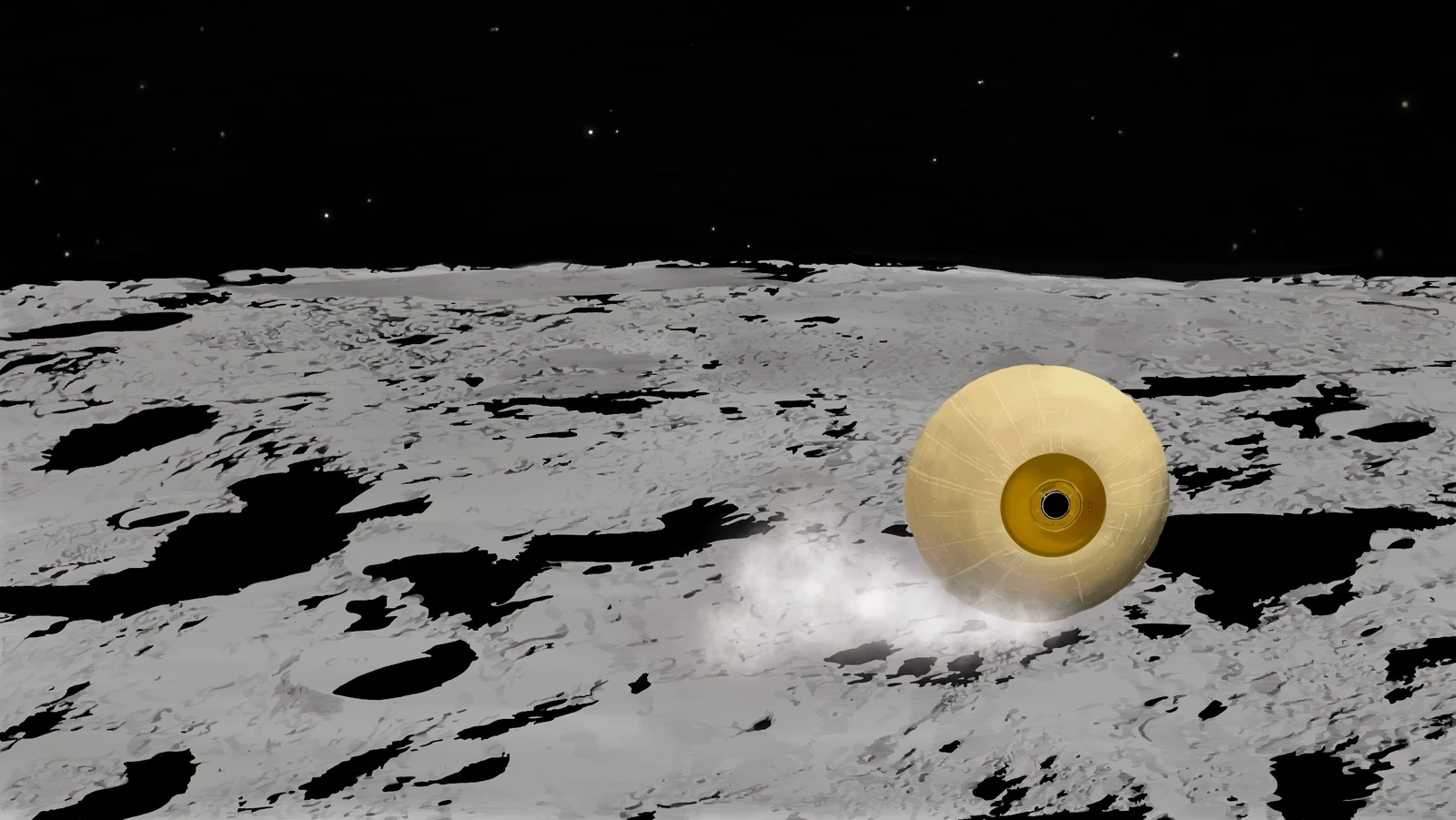
A spherical exploration rover with no wheels or legs is preparing for a mission to roll through permanently shadowed regions of the Moon in search of ice. Resembling an exercise ball, the robot can bounce its way down slopes, making it well-suited for exploring deep craters.
RoboBall, developed by researchers at Texas A&M University, is an inflatable spherical rover measuring 1.8 meters in diameter and weighing 150 kg. After more than five years of development, a prototype has been built and successfully navigated lunar-like terrain at a quarry in central Texas. IEEE Spectrum reported on March 3 (local time) that because the robot has no wheels or legs, it faces no risk of getting stuck in sand or tripping over rocks.
The limitations of conventional mobile rovers are well documented. NASA's six-wheeled rover Spirit, which landed on Mars in 2004, lost mobility in 2009 when its right rear wheel became stuck in sand, and communication was ultimately lost in March of the following year. The problem of tipping over on irregular terrain has been a long-standing challenge for space exploration robots.
The concept behind RoboBall dates back to 2003. Robert Ambrose, a professor of mechanical engineering at Texas A&M, came up with the idea of wrapping a lunar rover in an inflatable ball while working at NASA. A ball rolls—it doesn't fall over. The cameras and exploration equipment inside rotate in sync with the ball's movement to maintain their orientation.
The inflatable shell does more than just absorb impacts. It protects equipment from sharp rocks and dust while also insulating against extreme temperature swings. On the Moon, daily temperature variations exceed 200 degrees Celsius—climbing to 121°C during the day and plunging to minus 133°C at night. Inside craters that never receive sunlight, conditions are far colder still.
The researchers have identified Shackleton Crater at the lunar south pole as RoboBall's first target destination. This crater, which reaches a depth of 4 km, is an area NASA is evaluating as a potential site for an astronaut habitat. Scientists believe that because sunlight never reaches the crater floor, substantial amounts of water exist there in the form of ice. Water can be used for drinking, and when broken down, it yields oxygen and hydrogen—useful for breathing and rocket fuel.
The challenge is accessibility. Rovers with wheels or legs would struggle to safely descend a 4-km-deep slope. RoboBall can bounce down like a ball. It can also change direction: when the counterweight inside the sphere shifts left or right, the robot moves accordingly. On steep descents, the weight is shifted backward to slow the robot down.
Masahiro Ono, director of the Planetary Robotics Laboratory at Georgia Tech, praised the design, saying, "The best thing about RoboBall is its simplicity." He explained that while robots typically move using actuators, RoboBall has just two actuators, both housed inside the spherical shell where they are protected from dust and rock damage.
Sample Recovery via Rocket
The research team believes RoboBall could carry out a mission to return lunar rock and soil samples to Earth for the first time in half a century. NASA has not retrieved lunar samples since Apollo 17 in December 1972. RoboBall's sample collection and recovery would proceed in stages.
First, an uncrewed rover deployed from the lunar lander would travel to the crater rim and inflate RoboBall. RoboBall would then roll down the slope, deploy its equipment at a location with ice, and collect samples. However, it cannot climb back up on its own. The researchers devised a solution: loading the samples onto a small rocket and launching them up the slope. The rover would then recover the rocket and transfer the samples to a spacecraft bound for Earth.
Ambrose moved to Texas A&M in 2021 and ramped up RoboBall research in earnest. The following year, a 50-cm-diameter RoboBall II proved the concept's feasibility, and construction of the full-scale RoboBall III took 11 months. After initial quarry tests, torque was increased by 2.5 times, enabling the robot to hop over small obstacles and climb 20-degree slopes.
A paper published in an international journal last November documented RoboBall III—powered by a high-capacity battery—descending quarry slopes and traversing soft, sand-like terrain. An experiment in which a small rocket launched a simulated payload up a slope also succeeded. The prototype cost $250,000 to build.
The next step is enhancing durability. Ambrose said he plans to make the outer shell tough enough to roll over steel debris and capable of withstanding temperatures as low as minus 184°C. Autonomous features that adjust the driving mode based on slope gradient are also being designed. Texas A&M is set to open the world's largest lunar and Martian terrain simulation facility in Houston later this year.
While additional research is needed before a lunar mission, there is potential to prove the technology's capabilities on Earth first. Rishi Jangale, a doctoral researcher and the paper's first author, said, "Imagine a swarm of RoboBalls deployed after a hurricane. These ball robots could map flooded areas and locate survivors."
The research was published in IEEE Transactions on Field Robotics.
Once added, BigGo Finance appears first in Google Search Top Stories, so you get the broadest, most up-to-the-minute, and most comprehensive global financial news first.
Add preferred source